
Najpierw wartość, potem technologia: dlaczego większość transformacji procesów kończy się porażką
Wnioski po webinarze MakoLab × FinTech Futures
W sektorze tak silnie regulowanym i złożonym jak usługi finansowe najtrudniejszym elementem każdej transformacji cyfrowej jest często samo wystartowanie. Zbyt wiele organizacji próbuje przyspieszyć ten pierwszy krok, stawiając na podejście skoncentrowane na narzędziach, by ostatecznie „potknąć się na pierwszej przeszkodzie”. 9 czerwca 2026 roku MakoLab Consulting oraz FinTech Futures zorganizowały webinar na żywo pt. „Value first, technology second: why most process transformations fail, and how to fix yours” („Najpierw wartość, technologia na drugim miejscu: dlaczego większość transformacji procesów kończy się porażką i jak to naprawić”) – aby zakwestionować właśnie ten odruch.
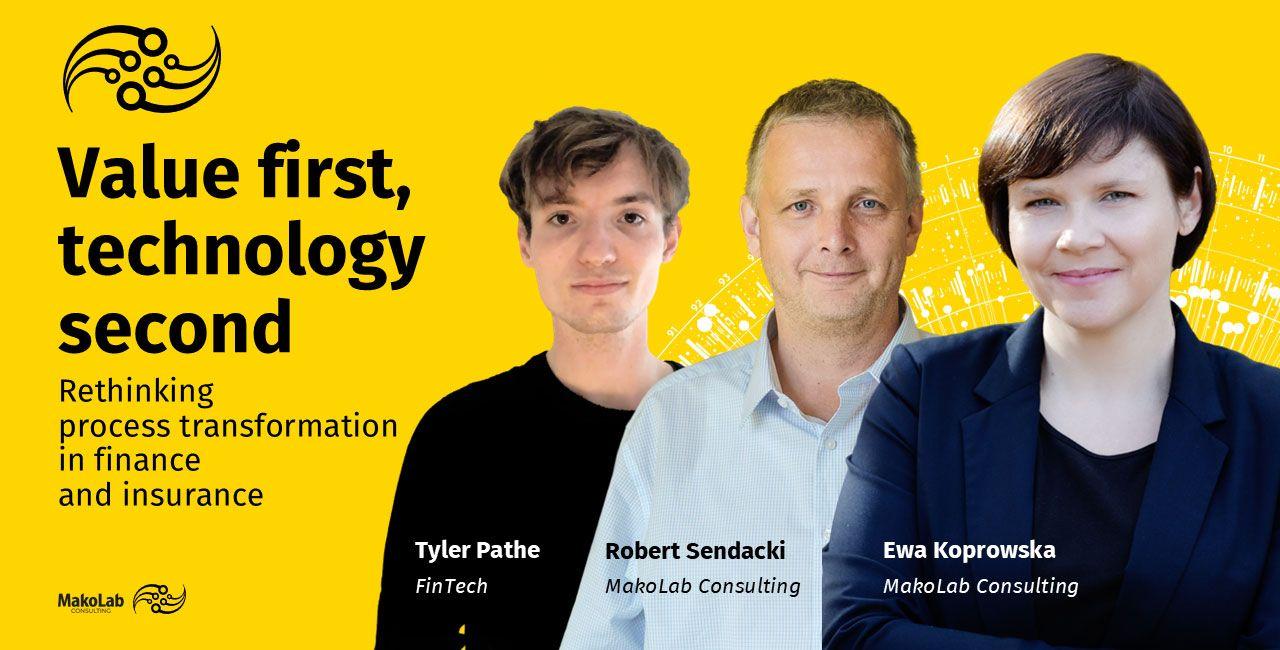
Led by Robert Sendacki (Co-founder & CEO of MakoLab Consulting) and Ewa Koprowska (Senior Project Manager), and moderated by FinTech Futures' Senior Reporter Tyler Pathe, the session turned decades of combined experience into an actionable strategy.
Drawing on dozens of enterprise projects and hundreds
of workshops for banks and insurers, the expert tandem laid out a value-first framework and a race-ready playbook for transformations that actually deliver.
Here are the key takeaways from the session.
(You can find details on how to access the full on-demand recording at the end of this article).
Dlaczego większość transformacji zaczyna się w niewłaściwym miejscu
When financial institutions discuss transformation, the conversation almost always opens with technology - new platforms, new vendors, and new capabilities. The trouble, however, is where that path leads.
The remedy is a fundamental shift in thinking: instead of asking "what system should we implement?", the teams start with "what value are we trying to create?" This single reframe drives the core sequence
of the entire webinar:
Goal → Metrics → Process → Technology
Followed in order, this framework strips away complexity and makes project outcomes far more predictable. Ewa Koprowska then dismantles the comfortable assumptions that quietly derail transformation projects: the myths that automation equals optimisation, that a new tool will magically fix a broken process, and that people will simply follow a new system once it goes live. In reality, none of these hold up. Automation does not repair a flawed process - it merely accelerates its flaws.
Hence, two distinct disciplines must be established before any tool is even considered. First comes the clarity test: if a team cannot describe a process simply, explaining who does what, when, and who owns it, it is simply not ready to be automated. Second is the enforcement of strict metrics. The opening question of any transformation, Ewa argues, must always be: "How will we know that we are doing well?" Her rule of thumb is to agree on just three or four metrics per process that can actually be measured with the data already at hand, allowing them to guide every subsequent prioritisation decision.
Projektowanie procesu przyszłości: klient, wartość, marnotrawstwo
The design, Robert explains, rests on three core pillars: the customer, the value each activity delivers, and the relentless elimination of waste.
Financial services, however, adds a unique twist: certain steps exist to serve not the end customer, but the regulator, whom Robert described as a "behind-the-scenes customer." Consequently, each activity faces a second round of rigorous questioning before it is cut. Yet, even with regulatory compliance factored in, a great deal of process architecture gets stripped away.
An example of a Ttechnique that carries a team from a messy as-is state to a leaner to-be workflow is the value stream map - an end-to-end view of every activity, owner, system, and bottleneck. Its biggest payoff, however, is fundamentally human:
This end-to-end visibility builds genuine staff buy-in. From there, transitioning to another technique, such as BPMN 2.0 model provides both business and IT with a single, shared blueprint, sharply reducing delivery risk.
Automatyzuj standard, pozostaw wyjątki ludziom
One of the most practical messages of the entire session was this: do not try to automate everything. While almost any process can technically be automated,
Robert conceded that the real driving factor must always be the return on investment.
As a rule of thumb, organisations should automate standard, high-volume, rule-based cases while leaving complex, judgement-heavy, and rare exceptions to human experts. Only then, with clear goals, defined metrics, and a clean process firmly in place, does technology selection become straightforward. This approach ensures that the silent killer of most enterprise transformations, integration with legacy systems, becomes a manageable task rather than a fatal roadblock. This is the race-ready playbook in miniature:
- map one real process this week without ever mentioning technology;
- agree on three to four success metrics;
- align business and IT on a shared BPMN model;
- and only then automate the standard cases.
The technology choice comes last, with every single phase strictly kept inside a fixed time-box.
Podsumowanie
Value-first transformation fundamentally reorders the work, placing goals and metrics first, a clean and agreed process next, and technology last, ensuring that enterprise change is measurable, widely adopted, and genuinely cheaper to run. If a single statistic captured exactly why this sequence matters,
it was the one Robert cited during the closing Q&A session:
The full session - including the complete framework, the live insurance case study, and the entire Q&A -is available to watch on demand. Register on FinTech Futures to access the recording and the webinar's key takeaways.
Watch on demand on FinTech Futures →

Anna Kaczkowska
Specjalista ds. contentu
Odpowiedzialna za planowanie, tworzenie i zarządzanie treścią