

SEO i GEO w 2026 roku. Jak AI zmienia widoczność w wyszukiwarkach?
W marcu 2025 roku Google uruchomił AI Overviews w Polsce. Dla użytkowników, miało to oznaczać szybsze odpowiedzi. Dla zespołów SEO, był to początek nowych zasad widoczności. Wyszukiwarki nie tylko porządkują linki w rankingu, lecz samodzielnie tworzą odpowiedzi, zanim użytkownik kliknie w którykolwiek z wyników. I dzieje się to coraz częściej.
To nie jest kosmetyczna zmiana w sposobie prezentowania wyników. Wysoka pozycja w klasycznych wynikach nie jest już najważniejszym wyznacznikiem widoczności . Coraz istotniejsze staje się to, aby treści były wiarygodne, konkretne, aktualne i wystarczająco dobrze ustrukturyzowane, aby mogły być wykorzystywane lub przywoływane przez systemy generatywne.
Na scenę wkracza optymalizacja pod kątem silników generatywnych (GEO), rozumiana nie jako następca SEO, lecz jako jego rozszerzenie poprzez widoczność w odpowiedziach generowanych przez sztuczną inteligencję.
Co tak naprawdę się zmieniło?
Zamiast kierować użytkowników do odpowiedzi, przeglądarki same generują odpowiedzi z coraz większą częstotliwością. AI Overviews działa już w ponad dwustu krajach i w czterdziestu językach. Polska dołączyła do wdrożenia w 2025 roku. Google równolegle rozwija tryb AI Mode i otwarcie przyznaje, że pytania zadawane przez użytkowników są coraz dłuższe i coraz bardziej złożone. Aby tworzyć odpowiedzi czerpane jednocześnie z wielu źródeł, systemdzieli pytania na powiązane pod-zapytania, proces znany jako query fan-out.
Efekt jest zarówno wymierny, jak i mierzalny. Dane Pew Research Center pokazują, że gdy Google wyświetla wyniki z AI Overview, użytkownicy rzadziej klikają w klasyczne linki. W przypadku analizowanych wizyt wskaźnik klikalności (CTR) dla tradycyjnych wyników wynosił 8% na stronach z podsumowaniem AI, wobec 15% na stronach bez niego. Linki cytowane bezpośrednio w podsumowaniu AI klikano zaledwie w 1% wizyt. Żadna dalsza akcja nie miała miejsca w 26% wizyt z podsumowaniem AI oraz w 16% wizyt bez niego.
I właśnie w tym miejscu GEO zaczyna mieć praktyczne znaczenie. Jeśli nawet tylko część decyzji jest podejmowana już na etapie wyników wyszukiwania, samo pojawienie się na liście linków nie wystarcza. Konieczne staje się zapewnienie, że Twoje treści są wystarczająco jasne, wiarygodne i odpowiednio umieszczone w kontekście, by mogły zostać przywołane w odpowiedzi AI.
GEO zaczyna się tam, gdzie SEO dobrze wykonuje swoją pracę
The narrative that GEO is replacing SEO isn’t hard to find in the industry media. It’s an appealing thesis, but it fails to capture how search engine visibility actually works. Google hasn’t created a separate set of rules for AI Overviews and AI Mode. There are no secret files, dedicated schemas or magical meta tags that open up a path to AI-generated answers.
The starting point for website owners remains the same; crawl; indexation; key content text accessibility; information architecture; page experience; coherent, consistent business data; and content that helps people.
In recent years, Google has been reinforcing the old rules rather than thinking up new ones. Content should be helpful; it should be created for people and not mass produced solely to grab traffic. The company is also intensifying its crack down on practices whereby websites leverage their authority to publish poor quality or loosely related content simply to climb the ranking. Domain power alone is ceasing to be enough if there is no trust behind it. What’s changing, then, isn’t the foundation of quality, but the place where that quality can be put to use.
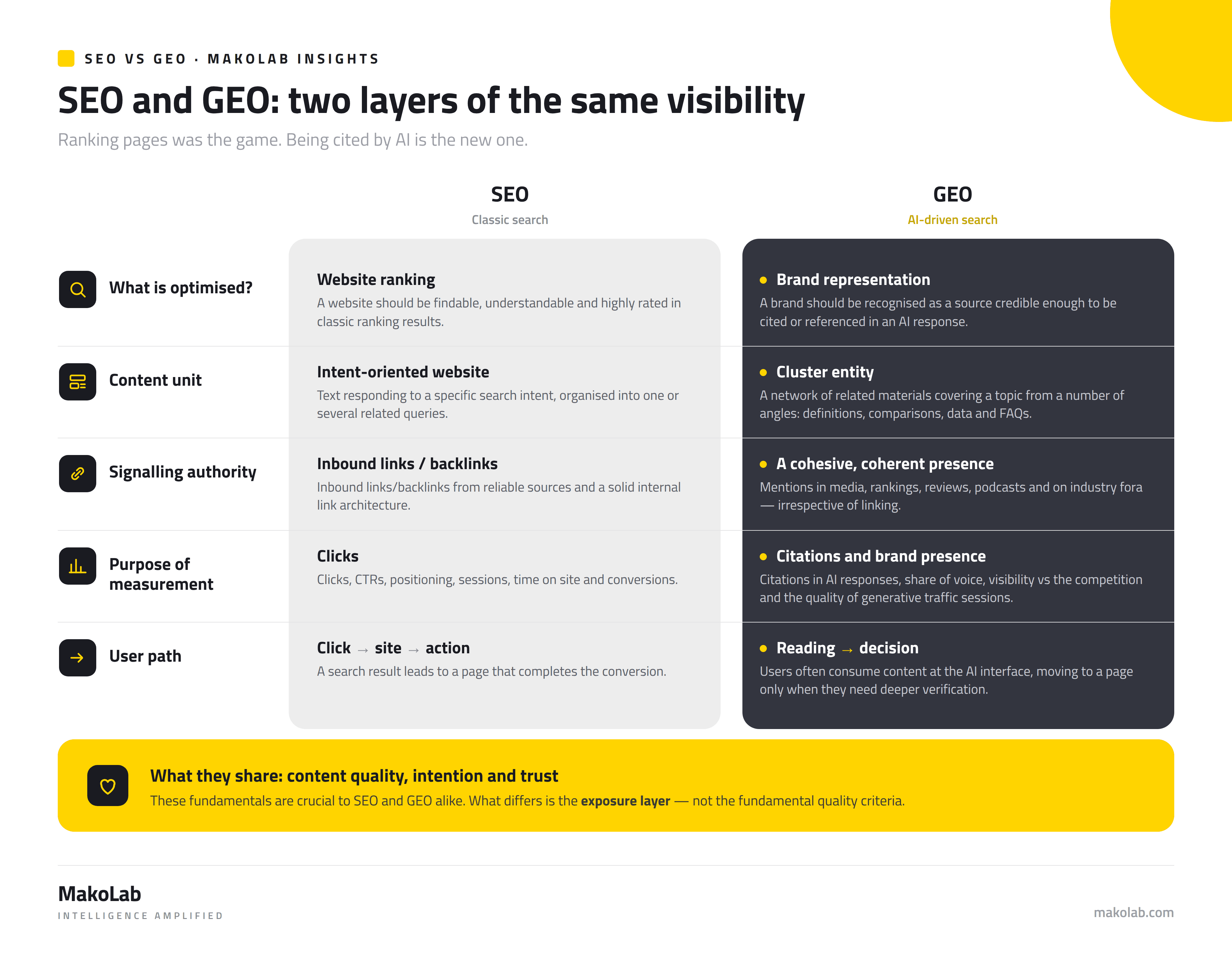
Czym różnią się SEO i GEO?
Różnica nie polega na tym, że SEO generuje kliknięcia, a GEO wzmianki, lecz na tym, że każde z nich ma inny środek ciężkości. SEO działa przede wszystkim na stronach internetowych i ich pozycji w wynikach wyszukiwania. GEO również działa na rzecz reprezentacji marki w szerszym ekosystemie źródeł.
Jak planuje się treść? Wokół tematów, a nie fraz
With old-school SEO, the most costly habit is producing texts in line with the ‘one phrase, one article’ logic. In 2026, that model is scaling with constantly decreasing efficacy. Given that search engines can break questions down into related subtopics, content performs better when it encompasses the topic more broadly, with a definition, context, comparison, risks, data and a concrete recommendation.
This doesn’t mean producing more content What it means is better knowledge architecture. From the GEO perspective, this entails several specific shifts in emphasis:
-
planning topic-focused hubs instead of separate, keyword-driven articles;
-
organising entities and the relationships between them;
-
linking between articles, service pages FAQs and case studies logically;
-
Investing in content containing your own input, like implementation data, comparisons, checklists, market observations and answering real client/customer questions.
An analysis from Ahrefs clearly demonstrates why keyword-driven ranking no longer tells the whole story. Only 18% of the citations in AI Overviews came from the websites in the top ten for the same search query. One keyword and one URL are no longer the beginning and end of visibility.
Brak autora, brak źródeł, brak daty? Samo E-E-A-T nie zbuduje zaufania
Nowadays, tone on its own doesn’t equate with expertise. That has to be built into the very structure of the material. The author’s name and their qualifications for writing on the topic need to be provided, along with a clearly defined scope and the sources of their data and the studies they cite. For high-risk topics, a description of the substantive peer review procedure should also be included. In its Quality Rated Guidelines, Google identifies trust as the most critical aspect of E-E-A-T, particularly when it comes to ‘your money or your life’ (YMYL) topics.
An analysis conducted by Ahrefs shows why, with GEO, it’s worth looking beyond your own website. The brands that are more frequently mentioned online also feature more frequently in AI Overviews. The correlation was 0.664; in other words, it was clear, although it doesn’t mean that a greater number of mentions alone automatically translates into a presence in AI responses. It is better treated as a signal that the entire context of a brand matters online. What counts is not only what a company publishes itself, but also where and how it is described by others.
To dobra wiadomość dla każdej marki, która posiada wiedzę i potrafi ją zaprezentować. Tekst napisany przez architekta rozwiązań, konsultanta, analityka, doradcę lub lidera wdrożenia, oparty na konkretnych decyzjach, błędach i rekomendacjach, buduje coś więcej niż tylko treść. Buduje źródło o wiarygodności, którą łatwiej ocenić i przywołać.
Brak technicznego SEO oznacza brak widoczności w AI
Your content may be brilliant, but if Google can’t download it, render it and understand it, then its potential remains limited. In terms of GEO, this is crucial, because before any material at all has a chance of appearing in AI-generated responses, it must be technically accessible.
There are several things that most often need watching:
-
indexing and crawling, so that Google can reach vital subpages effectively;
-
JavaScript rendering, particularly if the content, links or metadata only appear on the browser side;
-
the mobile version, since mobile-first indexing still means that this is the reference point;
-
internal metadata, canonical tags (canonicals) and links that should be available without unnecessary delay;
-
Structural data that help describe clearly what’s on the page and who is behind it.
A schema is neither a shortcut to AI Overviews nor a guarantee of better exposure. What it does do is help reduce ambiguities. We highlight what genuinely exists in the content and is of value to the user. An FAQ schema can still be used; however, its visibility as a rich result is extremely limited nowadays, so there’s no value in basing your CTR strategy on it.
Widoczność trzeba mierzyć szerzej
In all likelihood, this is the trickiest operational change. Google confirms that visibility in its AI features is included in the Seach Console standard performance report, without a separate channel for AI Overviews. This means you won’t see a straightforward ‘AI Overviews traffic’ column. At the same time, studies have shown that, when an AI response appears above classic results, users click more rarely.
The classic click-CTR-ranking set-up is simply not enough these days. Four more layers have to be added to it:
-
the share of brand-related questions and clicks;
-
brand visibility in AI citations;
-
the share of voice in generative responses;
-
organic session quality, microconversions and impact on the funnel.
Privacy also comes into play here. Consent Mode doesn’t create a banner on its own, but works in conjunction with the implemented consent management platform (CMP). Within the European Economic Area (EEA), the user’s choices must be passed on to Google tags, with an incomplete or poor rollout reducing measurement quality. Every CMP implementation and every platform migration, particularly in e-commerce, has to be flagged in analytics and cautiously interpreted. SEO data are still of value in 2026, but they are also more fragile than they were just three years ago.
It is also worth avoiding drawing conclusions from AI traffic too quickly. Ahrefs has described a case where 0.05% of visits from AI corresponded to 12.19% of registrations. This is not, of course, a universal rule applicable to every sector. It is, however, a strong signal that the characteristics of AI-driven traffic might differ from its classic organic counterpart. It will often be lower in volume, but more closely related to a specific intention.
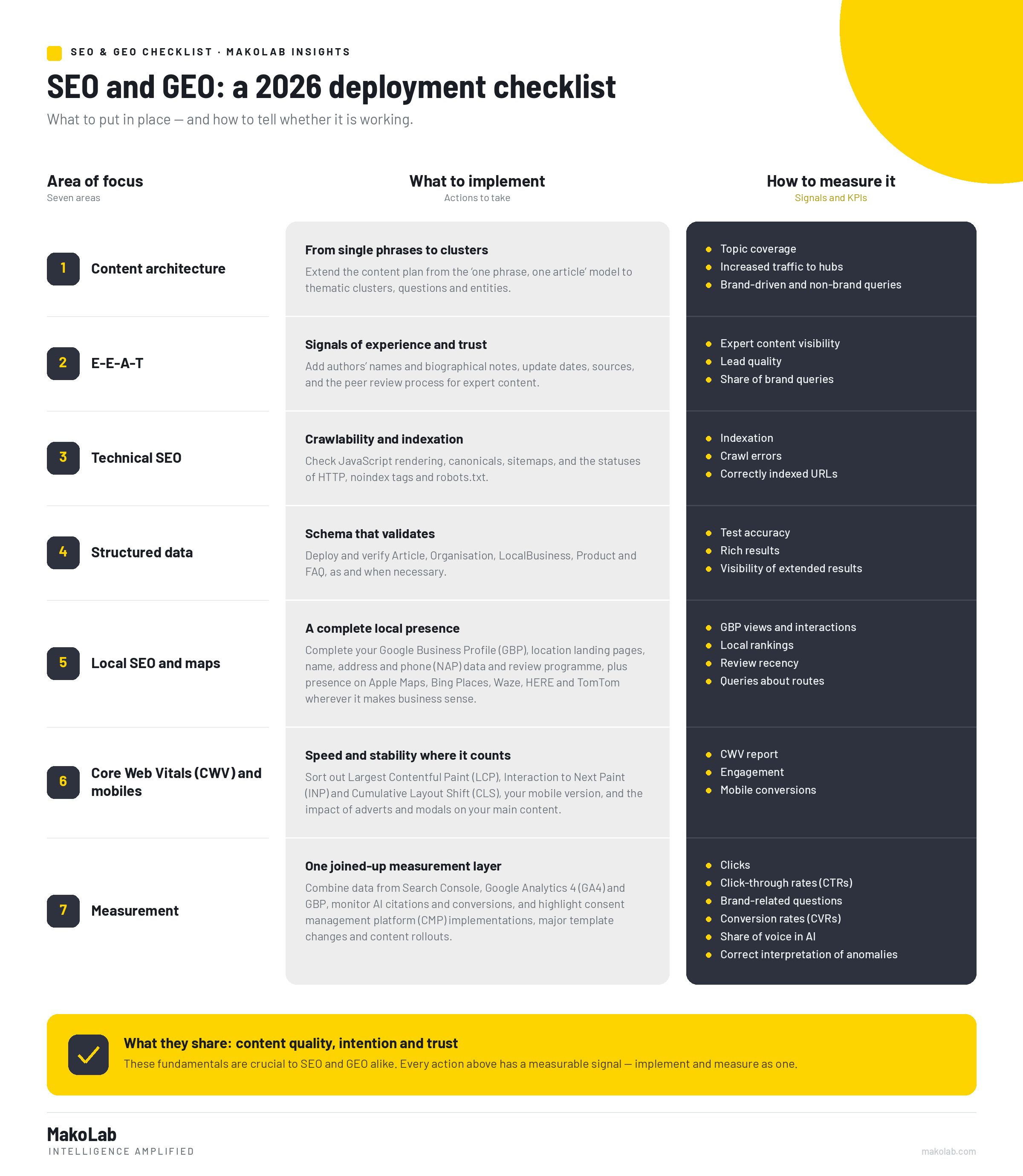
Lista kontrolna wdrożenia SEO i GEO na 2026 rok
Błędy, które najczęściej rujnują SEO i GEO
· Traktowanie GEO jako zamiennika SEO. To dwie warstwy tej samej widoczności, a nie konkurujące ze sobą strategie.
· Skalowanie treści bez własnego wkładu i dowodów eksperckości. Więcej tekstów nie oznacza większej wiarygodności.
· Liczenie na schemat FAQ jako taktykę zwiększania CTR. Ekspozycja wyników rich snippets typu FAQ jest obecnie skrajnie ograniczona.
· Ukrywanie kluczowych treści za problematycznym renderowaniem. Jeśli Google nie widzi treści, nagłówki tego nie naprawią.
· Brak lokalnych landing page’y w przypadku wielu oddziałów lub punktów obsługi. Profil firmy wymaga spójnego wsparcia ze strony witryny.
· Interpretowanie spadków danych po wdrożeniu Consent Mode lub migracji platformy jako pogorszenia SEO. Bez kontroli jakości pomiaru zbyt łatwo o błędne wnioski.
Strategia MakoLab w zakresie SEO i GEO
W MakoLab nie traktujemy SEO i GEO jako dwóch odrębnych światów. To jedna architektura widoczności, oglądana z dwóch poziomów. SEO zapewnia, że treść jest dostępna, poprawnie rozumiana i możliwa do oceny. GEO dodaje pytanie: czy marka jest wystarczająco dobrze opisana w całym ekosystemie, aby pojawić się w odpowiedzi generowanej przez AI?
Nie zaczynamy od listy pojedynczych optymalizacji. Zaczynamy od uporządkowania czterech obszarów.
1. Wiedza o marce, poprzez grafy wiedzy i ontologie opisujące produkty, usługi, kompetencje oraz relacje między nimi.
2. Widoczność w AI, poprzez monitorowanie odpowiedzi modeli językowych, kontekstu, konkurencji i tonu wypowiedzi.
3. Treść ekspercka, poprzez autorów, daty, źródła, dane z wdrożeń oraz realną odpowiedzialność za materiał.
4. Lokalność i dane, poprzez spójne opisy lokalizacji, usług i produktów, dane strukturalne, profile lokalne i mapy.
Dzięki temu zapewniamy, że technologia, treść, dane i pomiar nie działają w izolacji, lecz wspólnie dążą do tego samego celu. A jaki jest ten cel? Lepsza widoczność marki w całym ekosystemie wyszukiwania.
Nie zaczynaj od kolejnych tekstów. Zacznij od sprawdzenia, czy AI faktycznie rozumie Twoją markę
W MakoLab pomagamy naszym klientom uporządkować SEO, dane, treści i widoczność lokalną, aby zwiększyć szansę na obecność ich marki nie tylko w wynikach wyszukiwania Google, ale również w odpowiedziach generowanych przez AI.
Skontaktuj się z naszymi ekspertami. Podpowiedzą, od czego zacząć.
Źródła
1. Oferta pracy Starszy/a administrator/ka systemów, MakoLab SA, Łódź (pracuj.pl)
3. https://ahrefs.com/blog/ai-overview-brand-correlation
4. https://ahrefs.com/blog/ai-search-traffic-conversions-ahrefs
5. https://blog.google/products-and-platforms/products/search/google-search-ai-mode-update

Jacek Żmudziński
Dyrektor ds. GEO