
MakoDays 2026: AI, Data and Cybersecurity
The model was the easy part. That is how the PKO Leasing team summed up its deployment of AI to moderate listings on automarket.pl. By the speakers’ rough estimate, around 80%[1] of the work went into everything that allows a model to run in a live process: the application, orchestration, security, data and infrastructure.
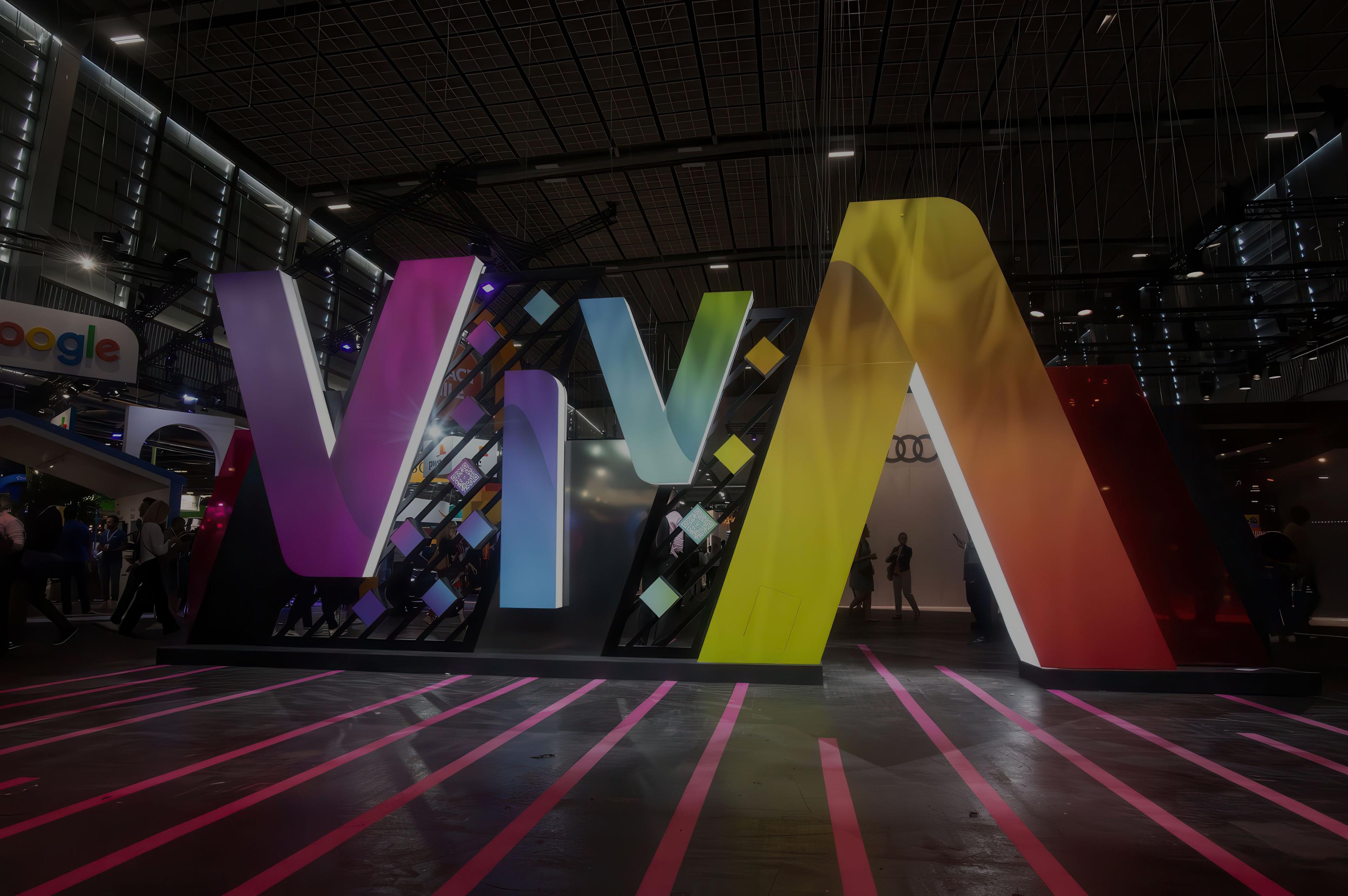
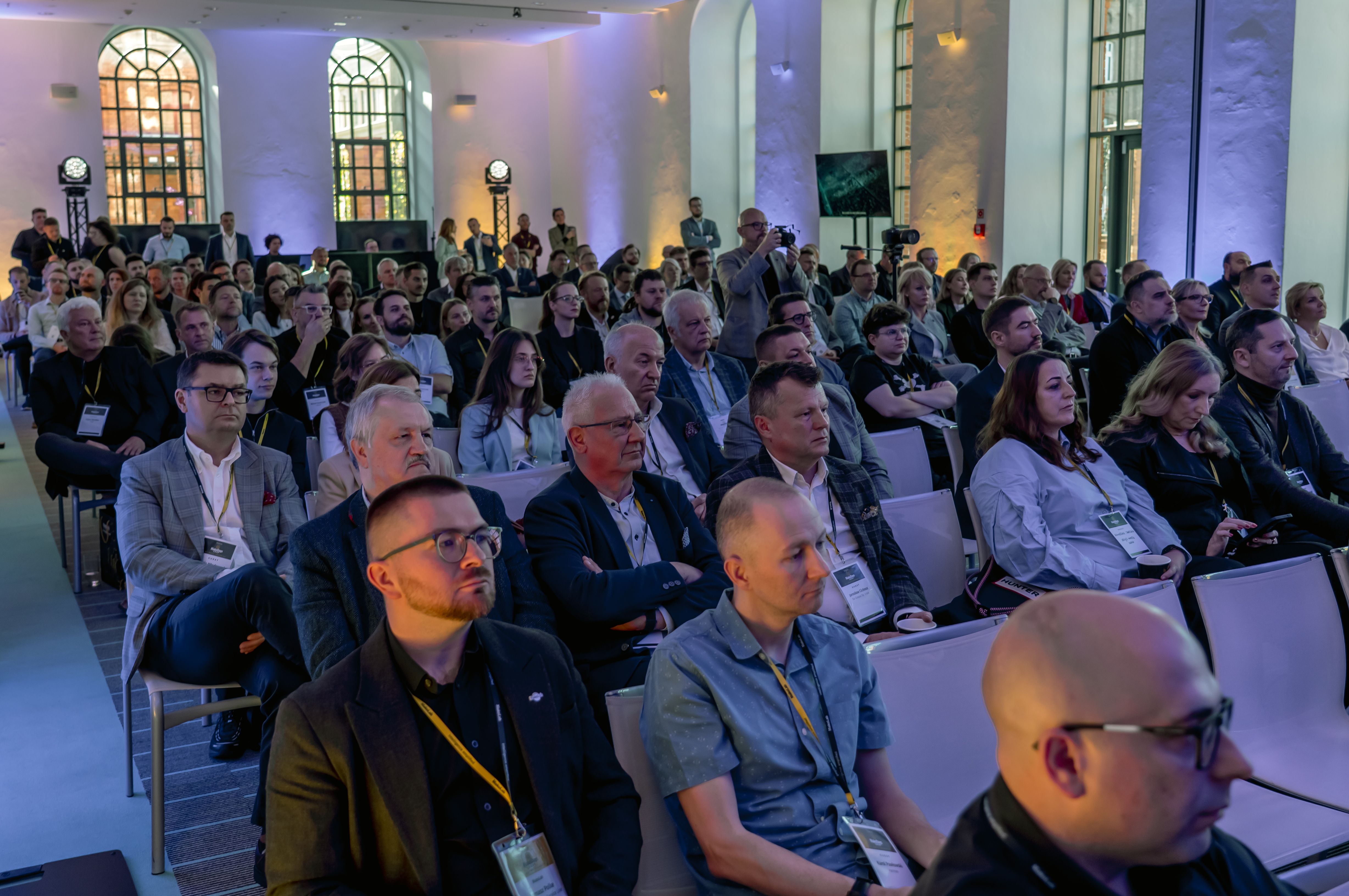
That captured the spirit of MakoDays 2026. Under the banner “Past the pilots. Into the returns”, we met in Łódź to discuss how to choose AI use cases, test their value and stay in control of the systems we run.
27-28 October 2026, Vienna House by Wyndham Andel’s Łódź. The programme focused on AI, data and cybersecurity, and included Cyber Box, a team-based cyberattack simulation.
Day 1: The rise of AI and its impact on business, work and cities
Following welcome remarks from MakoLab CEO Dariusz Głażewski and Łódź First Deputy Mayor Adam Pustelnik, MakoLab CTO Piotr Ignaczak drew a distinction that framed the day. A model merely answers questions; an agent uses a model, tools and permissions to carry out a task on its own. With agents, what matters is not only what a system knows, but also what it is allowed to do. He also noted that, excluding China, EU countries account for 5%[2] of documented AI compute, compared with 80%[2] for the United States.
He then borrowed three rules from his badminton coach. Timing: know why, what and when to automate. Eyes on the shuttlecock: choose the tasks before the model, with the data ready and an owner named. Footwork after your own shot: every deployment knocks the organisation off balance, so retest, monitor and keep a second model in reserve. Speed is not one of the rules.
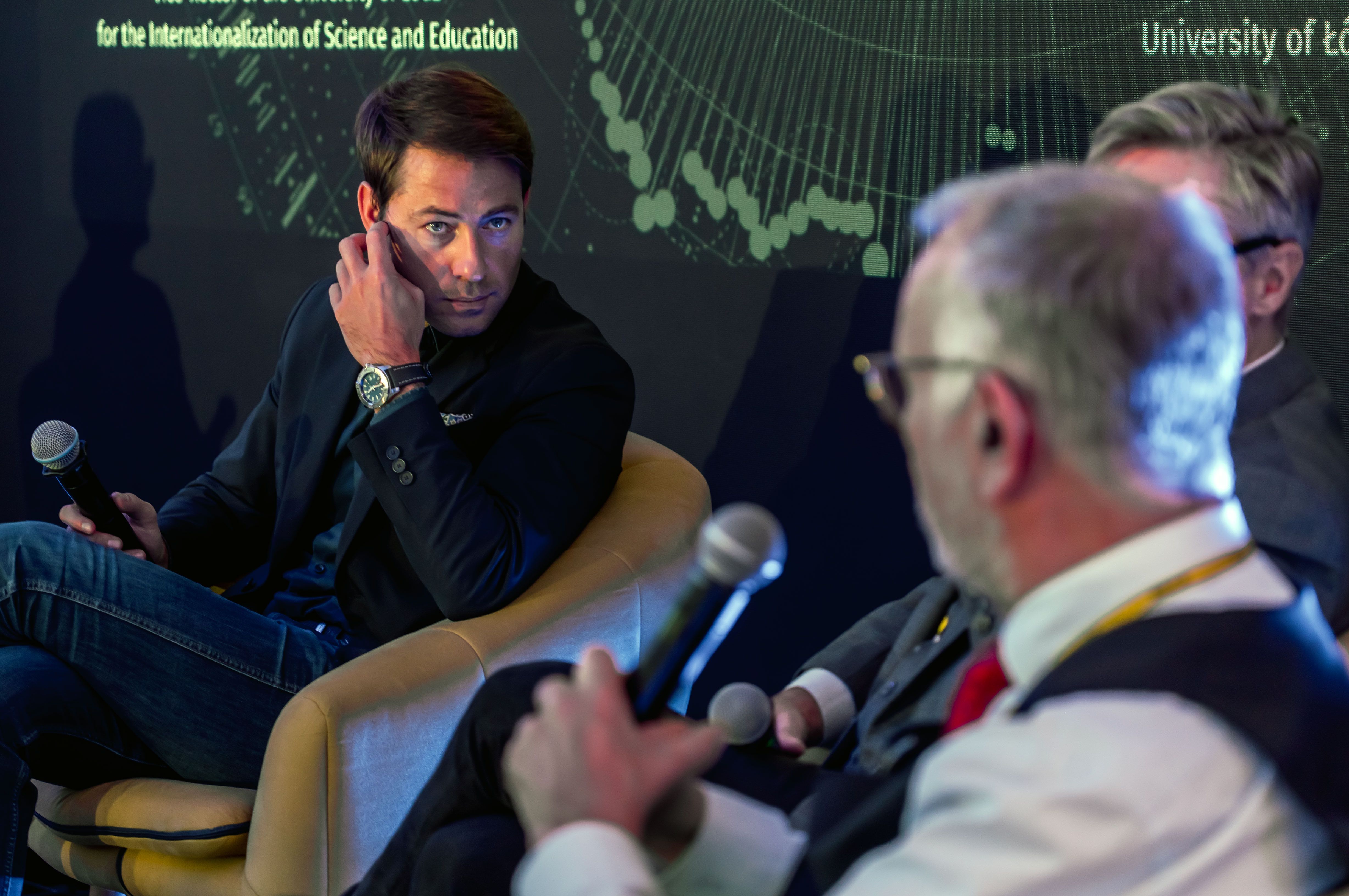
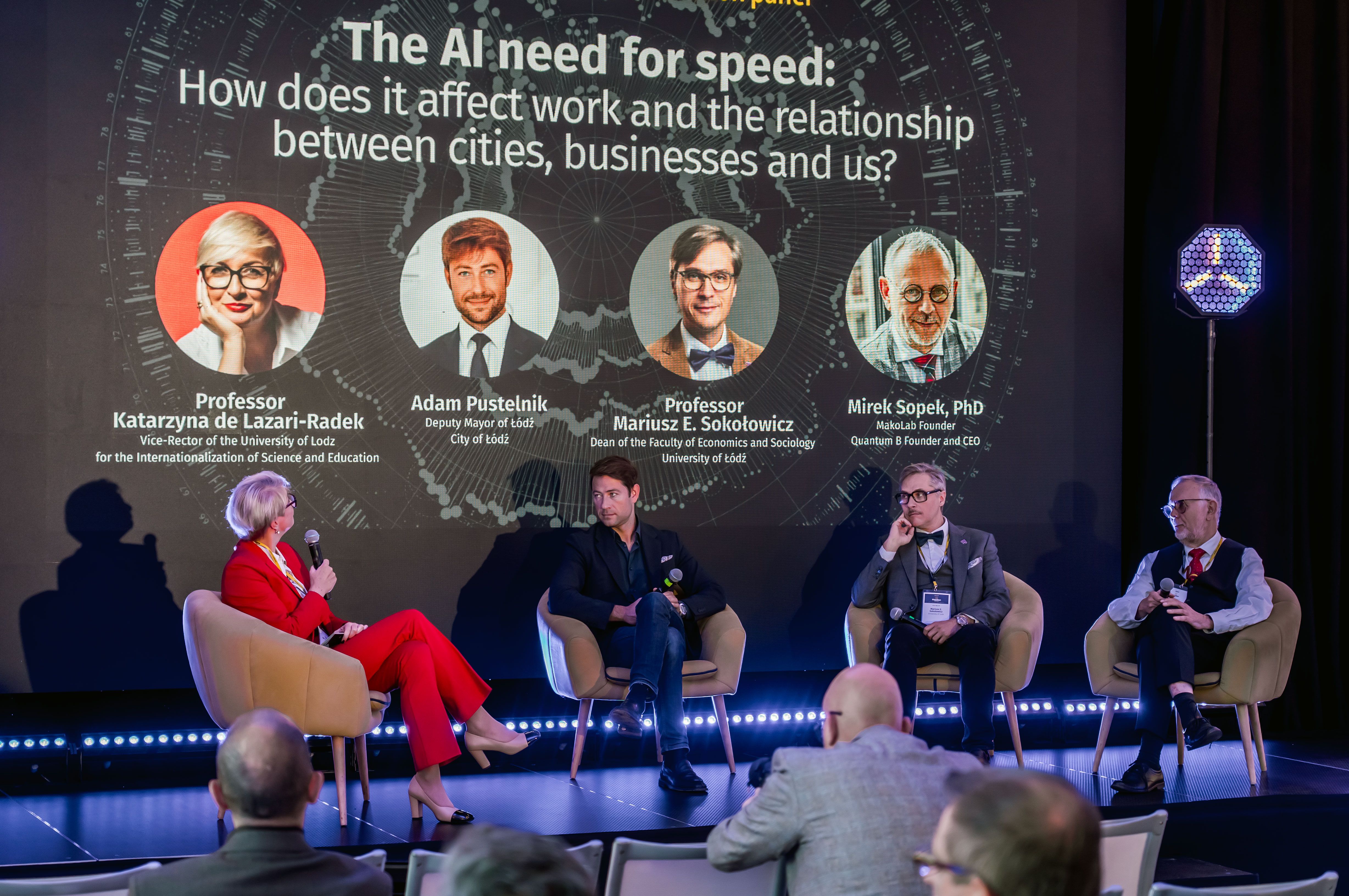
The panel “The AI need for speed”, moderated by Prof. Katarzyna de Lazari-Radek, Vice-Rector of the University of Łódź and an AI ethics expert, examined how fast-moving AI affects work and the relationships among cities, businesses and people. In his keynote, “Beyond LLMs”, Prof. Sören Auer of TIB and Leibniz University Hannover argued for neurosymbolic AI, which combines neural networks with rules and structured knowledge, as well as for agentic AI.
Decision intelligence and self-service analytics
Jacek Popko, Head of AI Services at MakoLab, presented decision intelligence: the design of business decisions using data and AI. A neural component reads unstructured data such as text, logs and images. A symbolic component, such as an ontology or knowledge graph of company concepts and business rules, filters out spurious correlations, flags results that break the rules and traces a recommendation back to its source.
Mateusz Kijowski, Head of Data Analytics and Engineering at MakoLab Consulting, covered self-service business intelligence, in which business teams use data directly instead of waiting weeks for a central team. Citing Zhamak Dehghani’s work on data mesh, he noted that organisations adopting this approach report reductions of as much as 60-70%[3] in the time from request to delivery.
AI in business: IDENTT, Renault, PKO Leasing and LS Airport Services
IDENTT. Aleksandra Nowak, Head of Digital Identity, showed how little it can cost to fool facial verification, ranging from a printed mask costing €0.83-1.66[4] to professional make-up costing €1,500-6,000[4]. One threat is a deepfake injected through a virtual camera. The fraudster never faces a lens, so the system must inspect the video stream itself.
Renault Polska. Mateusz Rakusa-Suszczewski, IS/IT Director for the CEE region, explained how Renault selects AI projects using five criteria: strategic fit, value, urgency, feasibility and resources. Value is reassessed at every funding decision. The Augmented Dealer pilot offered a lesson for any pilot: interest in a tool and frequent use do not, by themselves, demonstrate business value.
Renault showed how to select projects; PKO Leasing showed what it takes to deliver one. Agnieszka Walczak-Karbowska and Marek Obuchowski, Chief Product Owners, presented “Invisible AI”, a system for moderating listings on automarket.pl, which accepts listings from all users, not only dealers. AI acts as a decision gate: rules settle clear-cut cases, a language model selects one of three responses (approve, warn or block), and exceptions go to human moderators. This division of labour shows where automation’s independence ends.
LS Airport Services. Piotr Jaczyński, IT Manager, demonstrated an AI-assisted security operations centre (SOC) with a human in the loop. In one case, unauthorised software appeared on a workstation. It was digitally signed and was not recognised as known malware, yet it attempted to execute code directly in memory. The AI detected and blocked it, then passed the case to the SOC, where the analysis began. The team found not an attack but uncontrolled software (shadow IT), which it then blocked company-wide.
Who controls data, AI and cybersecurity?
The panel “Data. AI. Cybersec: Three rings of power. Who actually controls them?”, moderated by Szymon Augustyniak of Smart Tech Re:view, brought together Tadeusz Kifner of the Medical University of Gdańsk, Wojciech Zieliński of Sklepy Komfort, Bogusław Święcicki of Bakels Group and MakoLab’s Dariusz Głażewski. Drawing on perspectives from digital medicine, retail, industry and IT, they asked who in an organisation really holds the reins.
Dr Mirek Sopek, founder of MakoLab and CEO of Quantum B, presented quantum technology as both a threat and a shield. He cited a forecast that quantum computers capable of breaking today’s cryptography will arrive within 4-15 years[5]. Data intercepted now could therefore be decrypted later.
Dominik Lubasz and Dr Maria Dymitruk of the law firm Lubasz i Wspólnicy placed ten dates[6] on a single timeline, marking when AI and cybersecurity rules take effect under the AI Act, NIS2 and Poland’s KSC Act, and the Cyber Resilience Act (CRA). Five dates had already passed. The sixth, 28 October 2026[6], is when KRiBSI, the Polish AI regulator, can begin inspections and impose penalties. Their advice answered the earlier panel’s question: map roles, not tools. For each AI use case, establish whether your company is the provider, the deployer or both.
Piotr Ignaczak closed the day with a session on cyber resilience. One of his principles was that every incident should end with either a rule change or a written decision not to change the rule. Networking and one-to-one speed-consulting sessions with MakoLab experts ran alongside the stage programme. In the evening, the conversations moved to Stare Kino in Geyer’s Gardens.
Day 2: Are companies ready for AI?
Day 2 opened with live polls on corporate readiness for AI, followed by a panel led by Sabina Brożek-Rzewuska of Antal Market Research and based on a joint Antal and MakoLab study. While the first day showcased solutions, the study asked how organisations assessed their own readiness. Among 40 representatives of medium-sized and large organisations, 85%[7] said they were deploying AI. However, only 20%[7] strongly agreed that their organisation could explain, reproduce and defend an AI result in an audit; another 40%[7] partly agreed. The full Antal x MakoLab report series is available on our website.
Cyber Box: responding to a cyberattack as a team
Cyber Box combined escape-room puzzles, augmented reality and an AI assistant. Teams had 120 minutes[8] to stop a cyberattack by analysing clues and making decisions under time pressure. The exercise demonstrated that security depends not only on technology, but also on people, procedures and rapid decisions in a crisis.
From pilots to returns
What task should AI improve? How will the organisation know that it delivers value? Who steps in when the system makes a mistake? The projects presented at MakoDays 2026 offered concrete ways to answer these questions.
Thank you to all the speakers, partners and attendees. We look forward to seeing you at the next edition.
Sources
[1] A. Walczak-Karbowska and M. Obuchowski, PKO Leasing S.A., “Invisible AI: A content moderation case study at automarket.pl”, MakoDays 2026, 27 October 2026. Breakdown given by the speakers as approximate.
[2] P. Ignaczak, MakoLab, “The current state of AI”, MakoDays 2026, citing State of AI Report 2026 (N. Benaich, Air Street Capital) and Epoch AI.
[3] M. Kijowski, MakoLab Consulting, “From data to decisions”, MakoDays 2026, citing Z. Dehghani, Data Mesh: Delivering Data-Driven Value at Scale, O’Reilly Media, 2022.
[4] A. Nowak, IDENTT, “Identity verification in an age of fraud”, MakoDays 2026.
[5] M. Sopek, Quantum B and MakoLab, “Can quantum save cybersecurity?”, MakoDays 2026.
[6] D. Lubasz and M. Dymitruk, Lubasz i Wspólnicy, “Which clock are you on? Single AI.”, MakoDays 2026.
[7] Antal, “AI Readiness in Practice: Insights from Medium and Large Organisations Across Europe”, report for MakoLab, CAWI, n = 40, fieldwork 16 July-7 September 2026, published 26 October 2026.
[8] Event programme: makolab.com/mako-days-2026 and makolab.com/mako-days-2026/agenda (MakoLab, as of 29 October 2026).
Anna Kaczkowska
Content Marketing Specialist
Responsible for planning, creating and managing content