
The AI readiness series
A series of expert reports on what it really takes to run AI in production scrutinises the areas of infrastructure, software delivery, governance and reasoning. The reports are accompanied by a quantitative study conducted among European decision-makers to ascertain how far along their organisations are in the process. The research is by Antal, in partnership with MakoLab.One question, examined from every angle
How ready is your organisation to run AI rather than piloting it? Each report focuses on one area, probing deeply by way of desk research and interviews with MakoLab experts. The series is being released one report at a time during 2026.

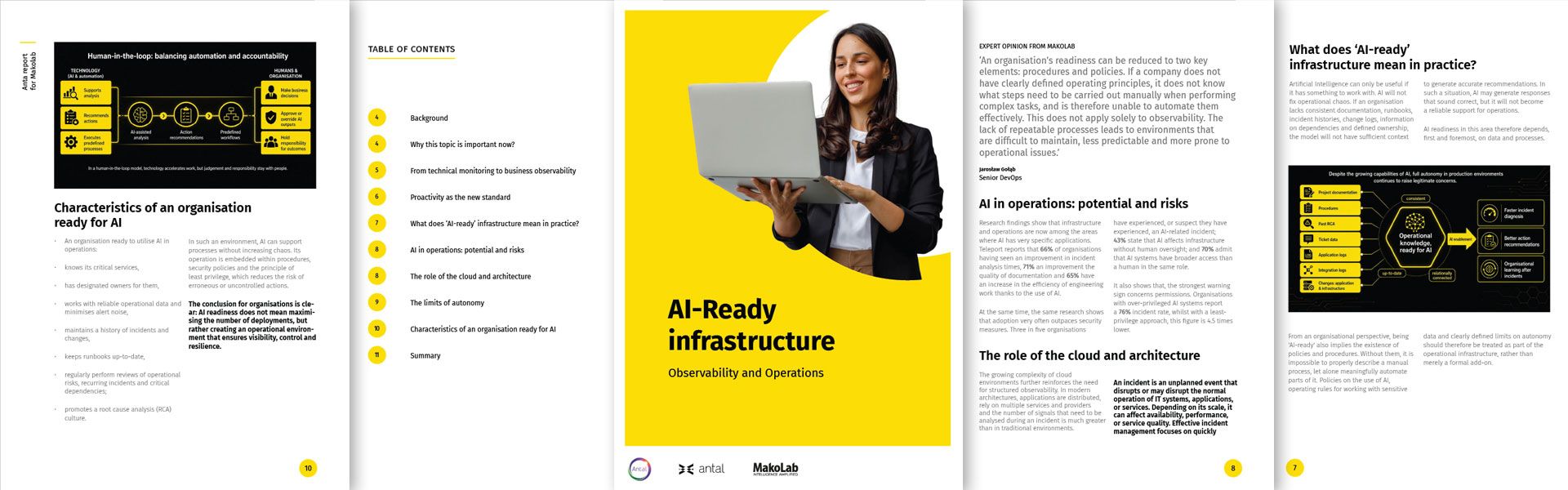
AI-Ready Infrastructure: Observability and Operations
Why can’t AI fix operational chaos? What separates technical monitoring from business observability? Which missing foundational capabilities are preventing AI from becoming useful in operations?

A New Way of Working: Managing Software Delivery Using Agentic Engineering
What is the real status of mature agent adoption across sectors? What's driving it? Which areas of delivery have to stay under human control? Where does accountability land for agent-produced outcomes?

AI Governance and Data Sovereignty: From Policy to Enforcement in European Enterprise
Where do European enterprises stand on governing AI in practice rather than on paper? How widespread is Shadow AI? Why do people bypass approved tools and can anyone detect it when they do?

Neuro-symbolic AI: Towards Precise, Governed, Explainable Reasoning
When does explainability go from being a nice-to-have to an essential? How much critical enterprise knowledge is still tucked away in documents and individual heads? What does it take to root AI in verified knowledge?
The strategic study is different
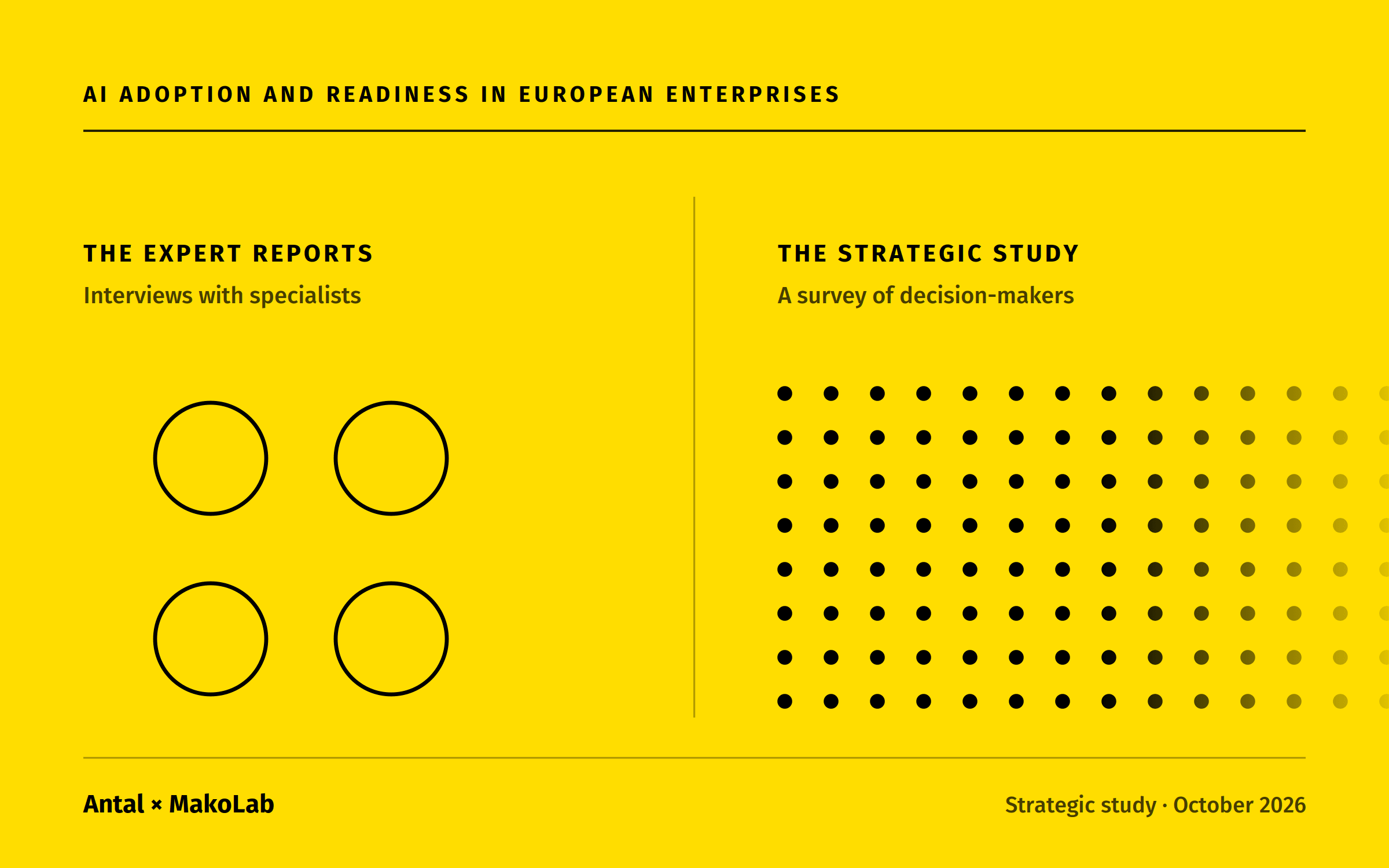
The expert reports are grounded in interviews with MakoLab specialists. The strategic study, on the other hand, is built on a survey conducted directly by Antal. The respondents were AI decision-makers at European organisations with 200 or more employees and the questions concerned their own programmes.
In practice, everyone says their AI programme is going well, yet almost nobody is ready to admit how far it has actually progressed. The strategic study, however, brought AI decision-makers at European organisations face-to-face with the questions they usually deflect, addressing not what they’re planning, but what stage they have, in fact, reached. Does their governance framework exist on paper or in practice? How much autonomy are they genuinely prepared to hand over within two years? In all honesty, how ready are they for the European Union’s Artificial Intelligence Act?
The four expert reports reflect what MakoLab’s specialists see is happening on the market. The strategic report provides a counterpoint by revealing what the market admits about itself.
The source of the numbers
Antal is an international recruitment and business consulting firm. Its consultants devote their days to conversations with the people who run technology inside European enterprises. which is how this study was able to zero in on decision-makers in particular, rather than respondents in general. Antal designed the research, conducted it and authored all five reports. MakoLab commissioned the programme. Our engineers were interviewed as subject matter experts and they reviewed the findings against what they see in production out on the market.

1. The strategic study reveals what is typical
As a quantitative study, it can give us facts like the number of organisations that have a governance framework and how many genuinely enforce it, for instance. What it cannot do is explore why the gap between the two exists. It provides the shape of the market and a benchmark to measure your own organisation against.
2. The four expert reports come direct from the front line
The interviews with practitioners describe the nuts and bolts, like how a monitoring stack fails in practice or what breaks the first time an agent gets commit rights. Those details cannot be extrapolated to build a general picture of an entire market. Neither are they meant to. The reports investigate the mechanics behind the percentages.
The strategic study is a quantitative CAWI survey conducted by Antal among AI decision-makers at European organisations with 200 or more employees across DACH, Benelux, the Nordics, France, the UK, the Republic of Ireland and CEE. The full methodology, including fieldwork dates and sample size, will be published with the report in October 2026.
The expert reports are based on desk research and focused interviews with MakoLab subject matter experts. The original sources of the external statistics cited are attributed, together with their publication dates.
Everyone’s monitoring. Almost nobody’s taking action
Ask any IT team for their CPU load, memory usage or uptime and you'll have an answer in seconds. Ask whether a customer actually managed to complete a purchase five minutes ago, though, or how much the last incident cost the business, and the room goes quiet.
This blind spot is the true barrier to AI in operations, not the models or the budget. Most organisations monitor their infrastructure efficiently, yet barely track their business processes at all. AI cannot close a gap that an organisation itself is unable to see.
Antal probed the European organisations it surveyed to uncover how deep this divide really goes and MakoLab’s engineers explained how closing it works in production.

The average level of market maturity in the area of observability remains mediocre. Observability is most often used reactively - companies only respond once a failure occurs or a problem begins to affect users. Meanwhile, the greatest challenge is the transition to a proactive approach, which allows potential problems to be anticipated before disruptions occur.
FAQ
 Who conducted the research?
 Who took part in the study?
 Do I have to fill in a form?
 When will the remaining reports be published?
 What is the difference between the strategic study and the four expert reports?
 Can the findings be discussed in the context of our own organisation?