
The comprehensive modernisation of the sjp.pwn.pl dictionary platform

Details
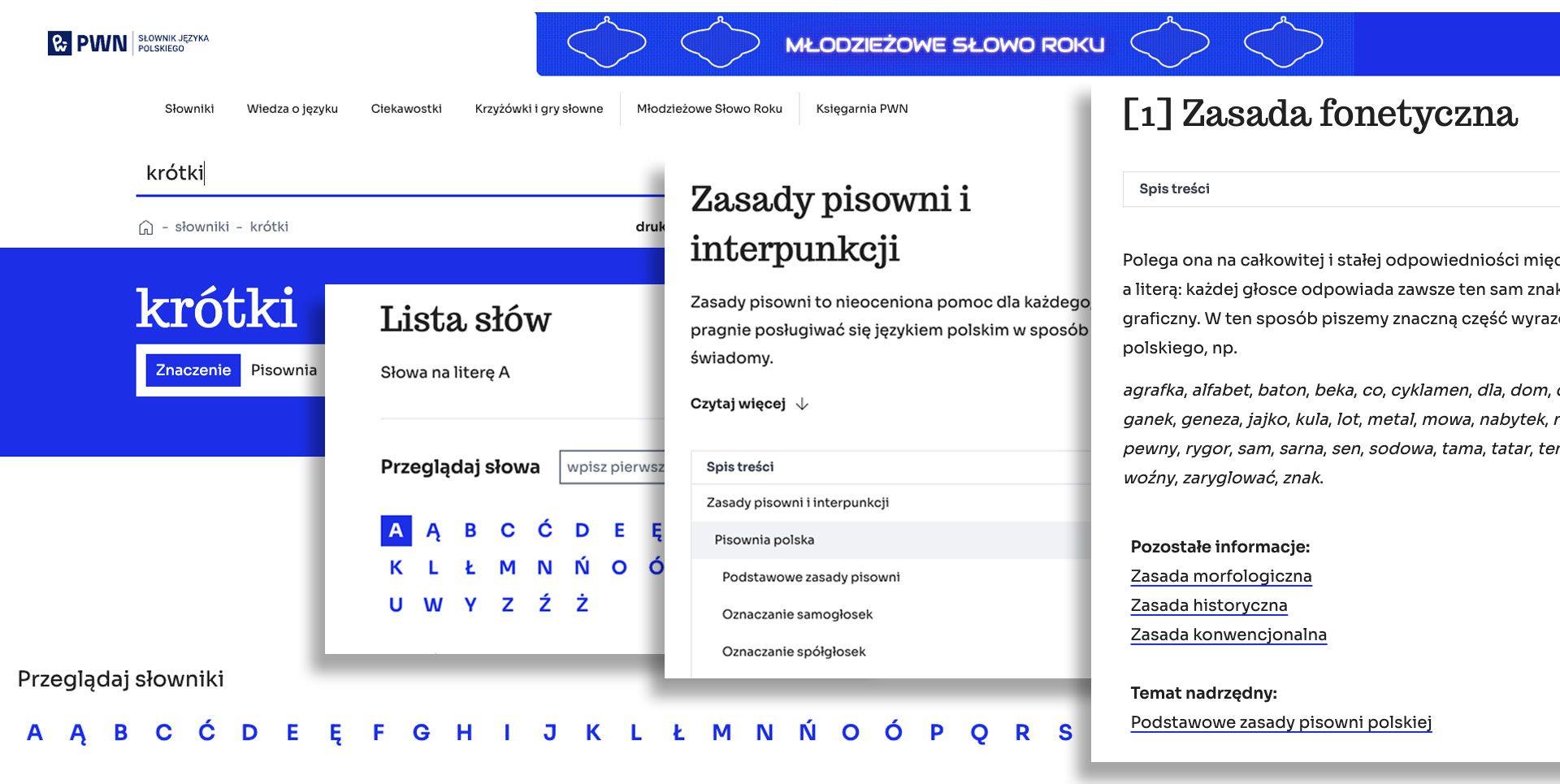
Wydawnictwo Naukowe PWN is an undisputed leader of Poland’s publishing and educational market. Its portfolio includes sjp.pwn.pl, one of the country's most visited online dictionary resources, and the highly popular Młodzieżowe Słowo Roku (Young People’s Word of the Year) poll. The company approached MakoLab with a requirement for the comprehensive, future-proof modernisation of those services.
Despite its immense popularity, the platform’s legacy technological infrastructure needed a fundamental overhaul. Our mission was to address several key strategic challenges:
- preserving and strengthening its dominant position in organic search results throughout the migration (SEO);
- ensuring full compliance with the WCAG 2.2 digital accessibility standard, making it accessible to all users;
- modernising the architecture for performance optimisation and reduced infrastructure maintenance costs;
- creating a scalable foundation ready to handle future traffic growth and functional development;
- integrating seamlessly with PWN's complex, internal linguistic databases.
Our primary objective was to engineer a state-of-the-art, high-performance, easily expandable dictionary platform. The new solution would need to boost organic search visibility, enhance the user experience (UX), boost accessibility and streamline editorial and maintenance workflows, while being capable of handling millions of sessions per month.
Our answer to these challenges was a modern architecture grounded in a microservices approach and a carefully selected technology stack. Leveraging an Agile methodology to work in close collaboration with the PWN team, we created and implemented an integrated ecosystem, as follows:
- front-end: Next.js with Incremental Static Regeneration (ISR), which delivered lightning-fast client-side performance and maximised the SEO potential. The ISR enabled the dynamic generation of static pages, dramatically reducing load times and ensuring high Core Web Vitals scores.
- back-end (CMS): Strapi CMS. Implemented as a flexible and intuitive content management system, this gives the editorial team full control over publishing workflows and the information architecture;
- search: Elasticsearch, which is a powerful engine guaranteeing precise and instantaneous search results across the extensive dictionary database, a critical UX component;
- integration: a dedicated API, ensuring smooth and secure communication between the new platform and PWN’s existing database resources.
The deployment of the new platform yielded immediate, measurable benefits that validated our technological and SEO strategy. Just two weeks after the launch, remarkable increases were observed:
· a 30% increase in indexed subpages in Google. This is a testament to the effectiveness of the new architecture and its crawler-friendly design;
· growth in top-ranking key phrases:
o a +4% increase in phrases in the TOP 3, from 60,000 to 62,500;
o a +6% increase in phrases in the TOP 10, from 94,000 to 100,600;
o +19% increase in phrases in the TOP 50, from 185,000 to 220,900.
· full compliance with the WCAG 2.2 standard, making the platform truly accessible and inclusive;
· a significant improvement in performance and reduced page load times, translating directly into a superior UX.
The +19% growth in TOP 50 phrases is particularly significant, as it demonstrates the service gaining visibility for entirely new keywords. This is a direct result of the freshly designed content sections, improved information architecture and effective internal linking strategy.