

Why your 48-month fleet contract is already problematic by the time you sign it and how predictive TCO can solve the issue
The economic landscape for corporate fleets has undergone a fundamental shift. Industry analyses of the evolution of fleet spend all point to a stark reality; total cost of ownership has risen materially since 2020. This is not simply a by-product of the transition to electric vehicles, either. On the contrary. The data suggest that macroeconomic inflationary pressures on every component, namely, vehicle prices, energy, labour and financing, are the primary drivers across all powertrain types. In an environment as volatile as this, a static TCO calculated at the start of a 48-month contract is no longer a reliable strategic compass. To stay competitive, the industry has to shift towards predictive TCO, a model that updates itself as the world changes.
What is predictive TCO?
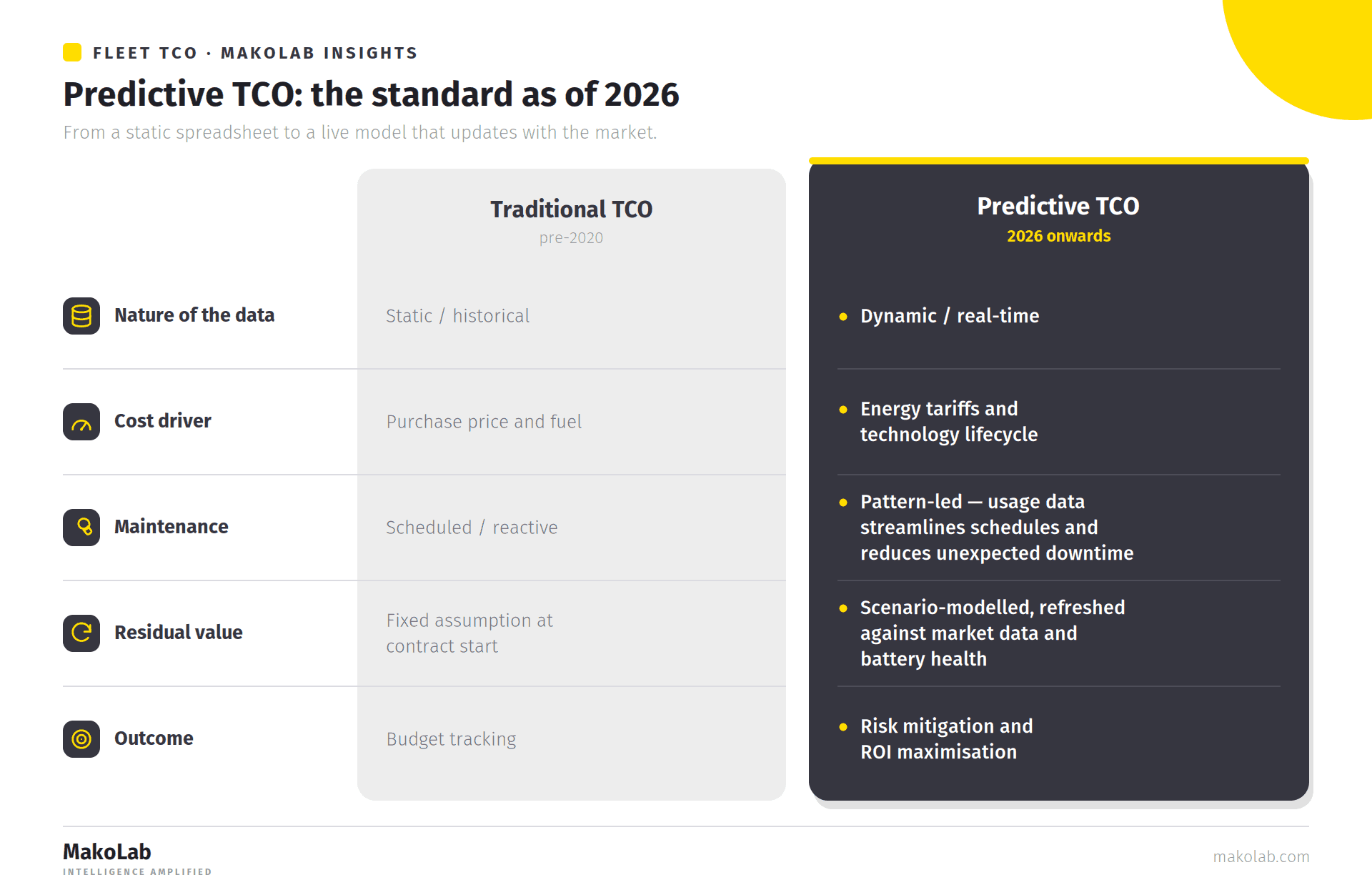
Predictive TCO is an advanced analytical framework that goes beyond retrospective accounting. It leverages real-time data integration and machine learning to forecast future costs before they occur, rather than after they have been recorded. Unlike traditional calculators, predictive models work with dynamic variables such as:
• energy price volatility, by anticipating fluctuations in electricity tariffs across regions, charging networks and times of day;
• software-defined residual value, by modelling how over-the-air updates and battery health influence a vehicle’s secondary-market value;
• infrastructure readiness, by factoring in the deployment speed of charging points and their impact on operational downtime.
Instead of after-the-fact reconciliation of things that have already happened, predictive TCO weighs up trade-offs between cost, efficiency and sustainability over time, facilitating data-driven planning for large-scale electrification and system-wide integration.
Meanwhile, the aforementioned balancing of trade-offs between cost, efficiency and sustainability means that predictive TCO does one thing that no static model can. It puts a stop to unpleasant surprises at the end of a contract.
It isn’t EVs that are raising your costs. The electrification paradox
Macroeconomic factors are doing more to drive cost increases than electrification is. Vehicle acquisition costs for battery electric vehicles (BEVs) are higher, but their service, maintenance and repair (SMR) costs are typically 20–37% lower than for their petrol or diesel equivalents over a fleet cycle of 36-48 months[1]. This means they remain one of the few effective levers for offsetting general inflation. However, the picture is genuinely mixed when it comes to accident claims, where BEV repairs are still over 25% more expensive on account of the high-voltage pack, although the gap is narrowing as repair networks gain experience[2].
Predictive models facilitate a like-for-like benchmark across segments, such as the C- and D-segments, for instance, proving that, when managed correctly, BEVs offer a competitive edge in the current cost environment, but only when the underlying assumptions about energy, utilisation and residual value are updated continuously and not locked in at the start of a contract.
Five levers that move the needle and how to pull them
As TCO becomes a central element of strategic fleet planning, industry leaders are consistently focused on five levers. At MakoLab, we translate those levers into digital capabilities, not slideware.
The five levers
• Select the right vehicle through intelligent interfaces that match each driver’s actual duty cycle to the most efficient segment and powertrain, rather than to a fleet-wide average.
• Optimise the contract through tools enabling leasing companies to analyse real-time mileage and usage patterns and adjust lease parameters dynamically, preventing financial shocks at end of the contract.
• Enhance driving styles through telematics integration that promotes eco-driving, directly reduces energy consumption and decreases mechanical wear and tear[3].
• Improve the charging strategy through moving beyond plug-and-charge to automated models that take off-peak tariffs, infrastructure availability and tax-compliant employee reimbursement into account.
• Include alternative mobility models through extending the framework to include bikes, car sharing and public transport for a holistic, total cost of mobility (TCM) view. TCM is the natural evolution of TCO once a fleet contains more than one mode of transport.
From vehicle TCO to fleet TCO
One of the most significant shifts now is the move from vehicle TCO, which covers the fixed and variable costs of each unit, to fleet TCO. The second, broader view captures costs that classic calculators have always missed, like administration, downtime, unfair wear and tear, end-of-contract reconditioning and the opportunity cost of suboptimal vehicle allocation across drivers. None of these line items show up clearly in a vehicle-level spreadsheet. Yet, together, they often determine whether a fleet will come in on budget or not.
Predictive maintenance is one of the clearest examples of where the vehicle-to-fleet TCO shift pays back. Predictive algorithms analyse telematics data, in other words, mileage, component temperature, vibrations, driving styles and ECU error codes, and then identify risk patterns and trigger interventions before a failure occurs. Real-world implementations report up to 30% reductions in maintenance-related downtime[3], which translated directly into TCO improvements that no static model would ever have surfaced.
How does MakoLab work with leasing companies to close the TCO gap?
At MakoLab, we don’t deliver off-the-shelf platforms. What we specialise in is building the custom-designed data ecosystems that power predictive TCO frameworks in production. Our expertise sits at the intersection of connected car APIs, energy provider data and financial services and we bridge the gap between ambitious sustainability strategies and the operational reality of running a modern fleet.
Which of our services do we leverage to do all that?
• Data Services, including data architecture, integration, big data and streaming pipelines that bring together vehicle telematics, energy prices, residual value forecasts and regulatory data into a single, governed and auditable model, where data assessment and governance ensure that the resulting fleet data are CSRD-ready.
• AI Services, providing the skill sets to build machine learning (ML) models for residual value, battery health and driver profiling, along with the ontologies and knowledge graphs that structure how vehicles, contracts, charging infrastructure and regulations relate to each other. All of this is the formal backbone of a decision engine that can reason, rather than just calculate. LLM and generative AI are also part of the service, making the engine accessible to fleet managers and corporate clients through natural-language interfaces.
• Application Services, covering both custom software development and DevSecOps for the decision interface itself. This is a securely deployed recommendation system that is integrated with existing leasing, ERP and HR platforms and gives fleet managers a concrete answer rather than three scenarios in a file.
• Business Services, encompassing business strategy and transformation work that translates the technology into commercial outcomes such as fleet policy redesign, customer experience for corporate clients and the operational change required for the new model to embed.
The race to 2030 will be won by the organisations that can make complexity simple for their clients. Understanding the ‘why’ of rising costs is the first step. Building the tools to manage them is the second.
Discover our practical approach to digital transformation and advanced platform development on the Azure cloud.
Read Arval case study
Sources
[1] Lex Autolease, SMR and running costs analysis for BEV vs. ICE fleet vehicles; Epyx 1link Service Network, real-world fleet data, 2024–2025; Fleet Assist, transaction value analysis.
[2] Thatcham Research, BEV repair and insurance reports (Innovate UK / Thatcham, 2023 and 2025 updates); Association of British Insurers, analysis of motor claims inflation, 2025; Gecko, risk repair cost tracking.
[3] Octo Telematics and EnVue Telematics, predictive maintenance case studies showing up to 30% reductions in maintenance-related downtime; MarketsandMarkets, Predictive Maintenance Market forecasts.

Anna Kaczkowska
Content Marketing Specialist
Responsible for planning, creating and managing content