

SEO and GEO in 2026. How is AI changing search engine visibility?
In March 2025, Google launched AI Overviews in Poland. For users, it was meant to herald faster answers. For SEO teams, it marked the beginning of new visibility rules. Browsers are not only ranking links, but are also compiling responses of their own accord before the user even clicks on any of the results. And this is happening with growing frequency.
This is no cosmetic change in the presentation of results. A high ranking in classic results is no longer the be-all and end-all of the visibility question. It is becoming increasingly crucial for content to be reliable, specific, current and structured enough to be used or referred to by a generative system.
Enter generative engine optimisation (GEO), understood not as a successor to SEO, but as its extension by way of visibility in AI-generated responses.
What’s actually changed?
Rather than linking users to answers, browsers are compiling the responses themselves with ever increasing frequency. AI Overviews is already up and running in more than two hundred countries and forty languages. Poland joined the deployment in 2025. Google is developing AI Mode in tandem and openly acknowledges that the questions users are asking are getting longer and more complex all the time. In order to build responses drawn from multiple sources at once, the system splits the questions into related sub-queries, a process known as query fan-out.
The outcome is both tangible and measurable. Data from Pew Research Center show that, when Google displays results from AI Overview, users click on classic links more rarely. For the visits under analysis, the click-through rate (CTR) for traditional results was 8% on pages with an AI summary, but 15% for those without it. Links cited directly in an AI summary were only clicked on in 1% of the visits. No further action occurred in 26% of the visits with an AI summary and 16% of those without one.
And this is where GEO begins to make practical sense. If even a handful of decisions are being made at the search result stage, then mere presence on the list of links is insufficient. There is a pressing need to ensure that your content is clear enough, credible enough and contextualised well enough to be referenced in an AI response.
GEO begins where SEO is doing its job properly
The narrative that GEO is replacing SEO isn’t hard to find in the industry media. It’s an appealing thesis, but it fails to capture how search engine visibility actually works. Google hasn’t created a separate set of rules for AI Overviews and AI Mode. There are no secret files, dedicated schemas or magical meta tags that open up a path to AI-generated answers.
The starting point for website owners remains the same; crawl; indexation; key content text accessibility; information architecture; page experience; coherent, consistent business data; and content that helps people.
In recent years, Google has been reinforcing the old rules rather than thinking up new ones. Content should be helpful; it should be created for people and not mass produced solely to grab traffic. The company is also intensifying its crack down on practices whereby websites leverage their authority to publish poor quality or loosely related content simply to climb the ranking. Domain power alone is ceasing to be enough if there is no trust behind it. What’s changing, then, isn’t the foundation of quality, but the place where that quality can be put to use.
How do SEO and GEO differ?
The difference isn’t that SEO generates clicks and GEO generates mentions, but that each has a different centre of gravity. SEO works primarily on websites and their ranking in search results. GEO also works on brand representation within a broader ecosystem of sources.
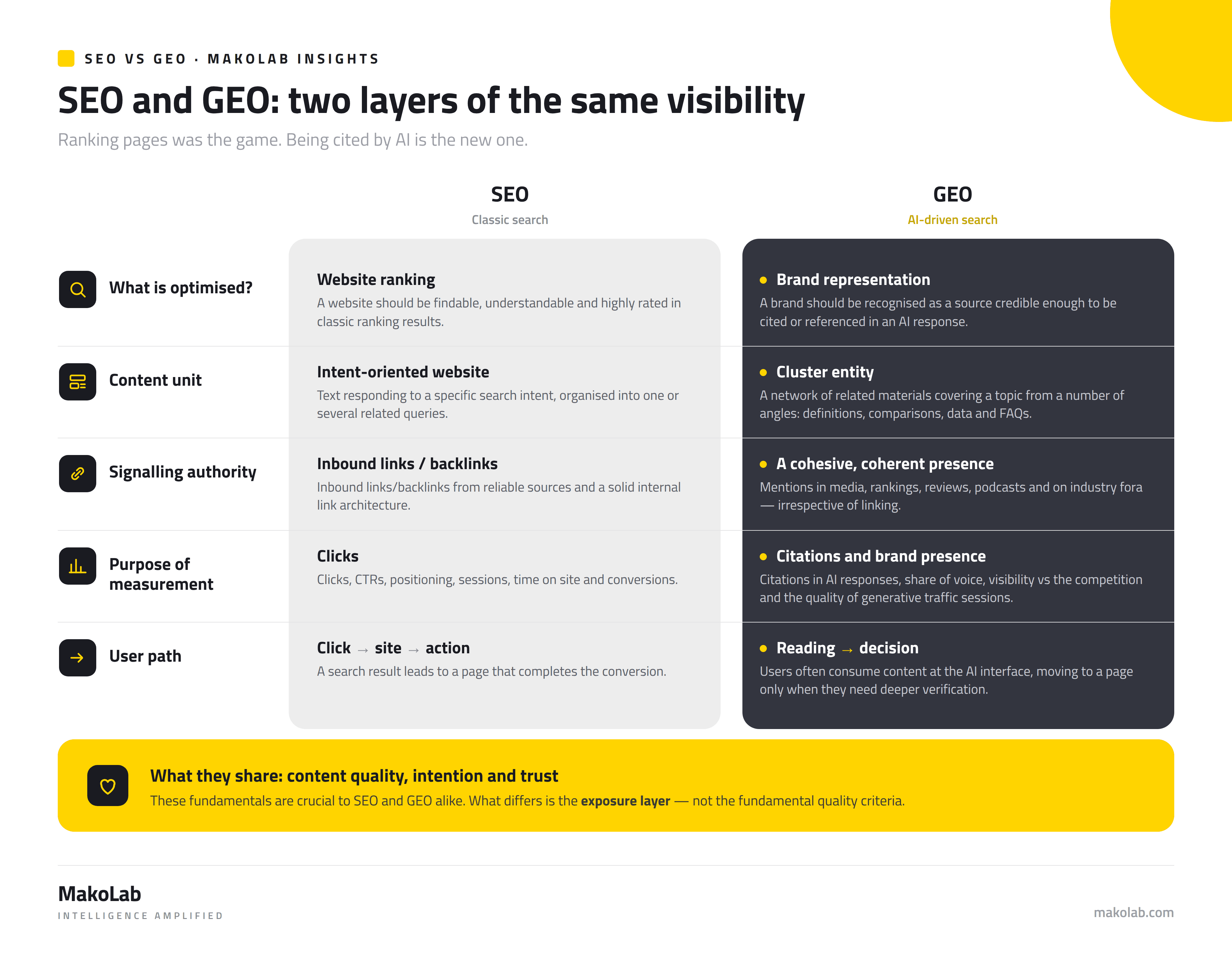
How is content planned? Around topics, not phrases
With old-school SEO, the most costly habit is producing texts in line with the ‘one phrase, one article’ logic. In 2026, that model is scaling with constantly decreasing efficacy. Given that search engines can break questions down into related subtopics, content performs better when it encompasses the topic more broadly, with a definition, context, comparison, risks, data and a concrete recommendation.
This doesn’t mean producing more content What it means is better knowledge architecture. From the GEO perspective, this entails several specific shifts in emphasis:
-
planning topic-focused hubs instead of separate, keyword-driven articles;
-
organising entities and the relationships between them;
-
linking between articles, service pages FAQs and case studies logically;
-
Investing in content containing your own input, like implementation data, comparisons, checklists, market observations and answering real client/customer questions.
An analysis from Ahrefs clearly demonstrates why keyword-driven ranking no longer tells the whole story. Only 18% of the citations in AI Overviews came from the websites in the top ten for the same search query. One keyword and one URL are no longer the beginning and end of visibility.
No author, no sources, no date? E-E-A-T doesn’t build trust alone
Nowadays, tone on its own doesn’t equate with expertise. That has to be built into the very structure of the material. The author’s name and their qualifications for writing on the topic need to be provided, along with a clearly defined scope and the sources of their data and the studies they cite. For high-risk topics, a description of the substantive peer review procedure should also be included. In its Quality Rated Guidelines, Google identifies trust as the most critical aspect of E-E-A-T, particularly when it comes to ‘your money or your life’ (YMYL) topics.
An analysis conducted by Ahrefs shows why, with GEO, it’s worth looking beyond your own website. The brands that are more frequently mentioned online also feature more frequently in AI Overviews. The correlation was 0.664; in other words, it was clear, although it doesn’t mean that a greater number of mentions alone automatically translates into a presence in AI responses. It is better treated as a signal that the entire context of a brand matters online. What counts is not only what a company publishes itself, but also where and how it is described by others.
This is good news for every brand in possession of knowledge and the skill to showcase it. A piece written by a solutions architect, consultant, analyst, advisor or implementation leader and grounded in concrete decisions, mistakes and recommendations builds something more than just content. It builds a source with a credibility that is easier to assess and cite.
No technical SEO means no visibility in AI
Your content may be brilliant, but if Google can’t download it, render it and understand it, then its potential remains limited. In terms of GEO, this is crucial, because before any material at all has a chance of appearing in AI-generated responses, it must be technically accessible.
There are several things that most often need watching:
-
indexing and crawling, so that Google can reach vital subpages effectively;
-
JavaScript rendering, particularly if the content, links or metadata only appear on the browser side;
-
the mobile version, since mobile-first indexing still means that this is the reference point;
-
internal metadata, canonical tags (canonicals) and links that should be available without unnecessary delay;
-
Structural data that help describe clearly what’s on the page and who is behind it.
A schema is neither a shortcut to AI Overviews nor a guarantee of better exposure. What it does do is help reduce ambiguities. We highlight what genuinely exists in the content and is of value to the user. An FAQ schema can still be used; however, its visibility as a rich result is extremely limited nowadays, so there’s no value in basing your CTR strategy on it.
Visibility needs measuring more broadly
In all likelihood, this is the trickiest operational change. Google confirms that visibility in its AI features is included in the Seach Console standard performance report, without a separate channel for AI Overviews. This means you won’t see a straightforward ‘AI Overviews traffic’ column. At the same time, studies have shown that, when an AI response appears above classic results, users click more rarely.
The classic click-CTR-ranking set-up is simply not enough these days. Four more layers have to be added to it:
-
the share of brand-related questions and clicks;
-
brand visibility in AI citations;
-
the share of voice in generative responses;
-
organic session quality, microconversions and impact on the funnel.
Privacy also comes into play here. Consent Mode doesn’t create a banner on its own, but works in conjunction with the implemented consent management platform (CMP). Within the European Economic Area (EEA), the user’s choices must be passed on to Google tags, with an incomplete or poor rollout reducing measurement quality. Every CMP implementation and every platform migration, particularly in e-commerce, has to be flagged in analytics and cautiously interpreted. SEO data are still of value in 2026, but they are also more fragile than they were just three years ago.
It is also worth avoiding drawing conclusions from AI traffic too quickly. Ahrefs has described a case where 0.05% of visits from AI corresponded to 12.19% of registrations. This is not, of course, a universal rule applicable to every sector. It is, however, a strong signal that the characteristics of AI-driven traffic might differ from its classic organic counterpart. It will often be lower in volume, but more closely related to a specific intention.
A SEO and GEO deployment checklist for 2026
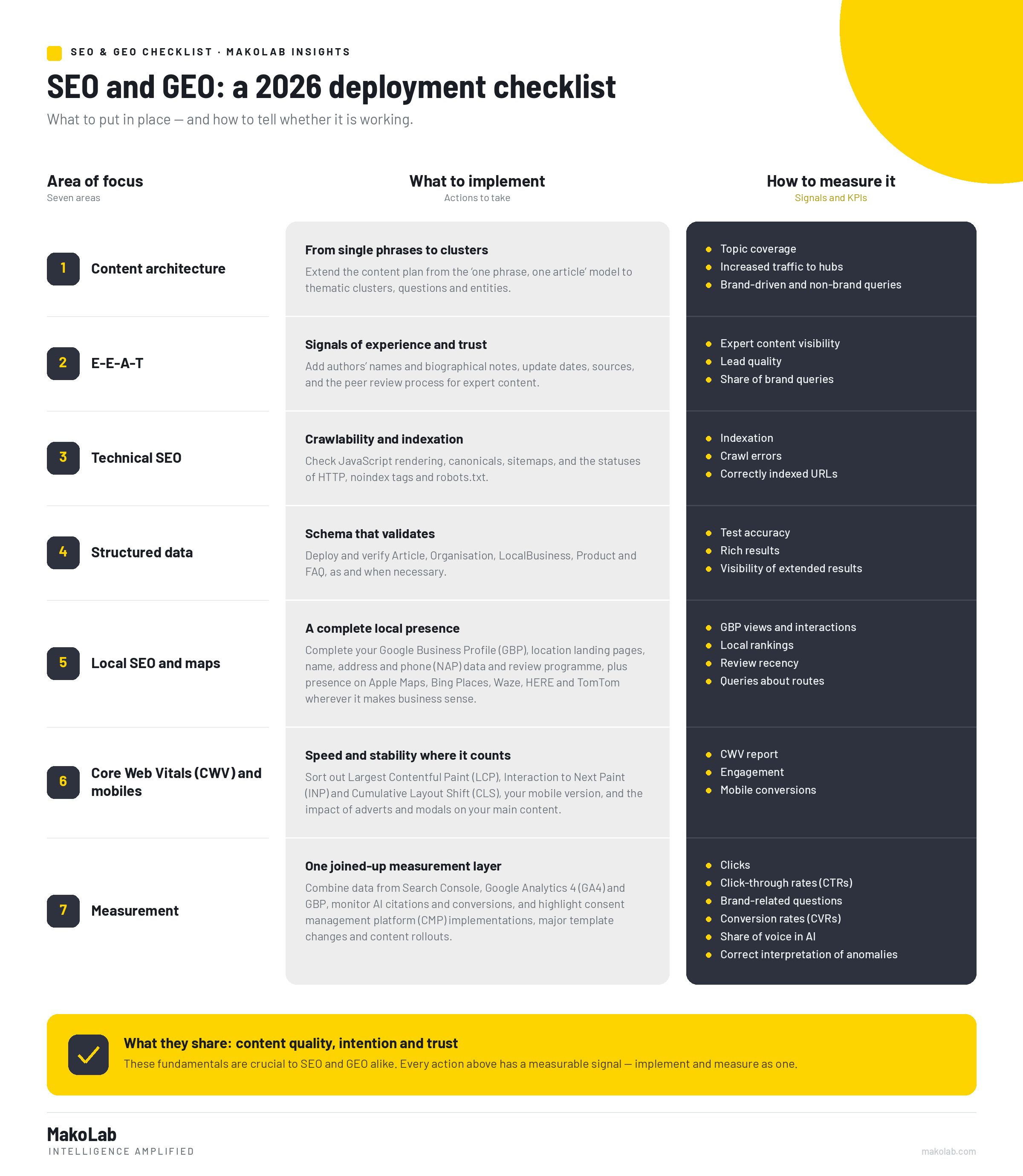
The errors that most frequently ruin SEO and GEO
· Treating GEO as a substitute for SEO. They are two layers of the same visibility, not competing strategies.
· Scaling content without your own input and evidence of expertise. More texts don’t mean more credibility.
· Counting on the FAQ schema as a CTR growth tactic. The exposure of FAQ rich results is extremely limited at present.
· Hiding crucial content behind problematic rendering. If Google can’t see the content, headings won’t solve the problem.
· The lack of local landing pages in the case of multiple branches or service points. A company profile needs coherent website support.
· Interpreting drops in data after implementing Consent Mode or a platform migration as a decline in SEO. Without measurement quality control, drawing wrong conclusions is all too easy.
MakoLab’s strategy for SEO and GEO
At MakoLab. we don’t treat SEO and GEO as two separate worlds They are one visibility architecture, but viewed from two levels. SEO ensures that content is accessible, correctly understood and can be assessed. GEO adds a question; is the brand sufficiently well described across the entire ecosystem for it to appear in an AI-generated response?
We don’t start with a list of individual optimisations. We begin by organising four spheres.
1. Brand knowledge, by way of knowledge graphs and ontologies that describe products, services, skill sets and the relationships between them.
2. Visibility in AI, by way of monitoring responses from language models, context, the competition and tone.
3. Expert content, by way of authors, dates, sources, data from implementations and the real responsibility for the material.
4. Locality and data, by way of cohesive descriptions of locations, services and products, structural data, local profiles and maps.
Doing this means we ensure that, rather than operating in isolation, technology, content, data and measurement are all working towards the same goal. And that goal is? Better brand visibility throughout the search ecosystem.
Don’t start with more texts. Start by checking whether AI actually understands your brand
At MakoLab, we help our clients organise their SEO, their data, their content and their local visibility to give their brand a greater chance of appearing not only in Google search results, but also in the responses generated by AI.
Contact our experts. They’ll show you where to begin.
Sources
1. Oferta pracy Starszy/a administrator/ka systemów, MakoLab SA, Łódź (pracuj.pl)
3. https://ahrefs.com/blog/ai-overview-brand-correlation
4. https://ahrefs.com/blog/ai-search-traffic-conversions-ahrefs
5. https://blog.google/products-and-platforms/products/search/google-search-ai-mode-update

Jacek Żmudziński
SEO Team Leader